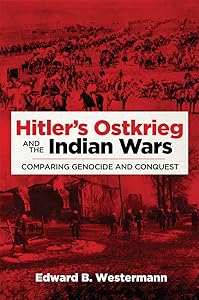
Hitler's Ostkrieg and the Indian Wars: Comparing Genocide and Conquest By Edward B. Westermann
As he prepared to wage his war of annihilation on the Eastern Front, Adolf Hitler repeatedly drew parallels between the Nazi quest for Lebensraum, or living space, in Eastern Europe and the United States’s westward expansion under the banner of Manifest Destiny. The peoples of Eastern Europe were, he said, his “redskins,†and for his colonial fantasy of a “German East†he claimed a historical precedent in the United States’s displacement and killing of the native population. Edward B. Westermann examines the validity, and value, of this claim in Hitler's Ostkrieg and the Indian Wars.
The book takes an empirical approach that highlights areas of similarity and continuity, but also explores key distinctions and differences between these two national projects. The westward march of American empire and the Nazi conquest of the East offer clear parallels, not least that both cases fused a sense of national purpose with racial stereotypes that aided in the exclusion, expropriation, and killing of peoples. Westermann evaluates the philosophies of Manifest Destiny and Lebensraum that justified both conquests, the national and administrative policies that framed Nazi and U.S. governmental involvement in these efforts, the military strategies that supported each nation’s political goals, and the role of massacre and atrocity in both processes. Important differences emerge: a goal of annihilation versus one of assimilation and acculturation; a planned military campaign versus a confused strategy of pacification and punishment; large-scale atrocity as routine versus massacre as exception.
Comparative history at its best, Westermann’s assessment of these two national projects provides crucial insights into not only their rhetoric and pronouncements but also the application of policy and ideology “on the ground.†His sophisticated and nuanced revelations of the similarities and dissimilarities between these two cases will inform further study of genocide, as well as our understanding of the Nazi conquest of the East and the American conquest of the West. Hitler's Ostkrieg and the Indian Wars: Comparing Genocide and Conquest
Hitler says to Wehrmacht leaders posed to invade the East, “Close your hearts to pity. Act brutally. Eighty million people (settlers) must obtain what is their right. Their existence must be made secure. The stronger man is right.†Wow, sounds like an present day Israeli cabinet meeting. Hitler & Company obsessed about space and place. White people are the most obsessed group in history with taking shit that doesn’t belong to them, so all this German Lebensraum talk only meant taking someone ELSE’s space and place. Himmler’s Plan was referred to by one historian as a “timetable for the extinction of the entire population of Eastern Europe.†“If Hitler envisioned the conquest of the American West as a process that included the murder of millions, then he could also imagine the subjugation of German lebensraum in the East through a process of mass annihilation.†Hitler’s plan in fact was serial genocide, a rolling genocide headed east, creating an empty landscape for German settlers to settle and multiply. The push to the East was considered necessary for the “survival†of the state. To help this plan along Alfred Rosenberg abolished all education above fourth grade in the East unless they were racially valuable. Hitler conflated Jews with Bolshevism which only an idiot would believe but soon many did, thus enabling Operation Barbarossa later. Hitler said, “Here in the East a similar process will repeat itself for a second time as in the conquest of America.†Non-German workers were worked slowly to death because the fewer the non-Germans, the more room for German settlers. Most of us envision the invasion of Russia happening with regular German tanks and big trucks; think instead of 750,000 horses pulling supply wagons and artillery. The resemblance to American wagon trains invading foreign western lands was painfully clear. The German front was 1,000 long, Russia had to throw its people and materiel at the invaders to slow them down. A whopping 3.3 million Soviet POWs “died in German captivity†and absence German morals were a fine incentive for Russians to fight Germans to the death. But German supply lines became more and more stretched while Russian supply lines became shorter and shorter, and because Hitler evidently never learned his von Clausewitz, nor understood the power of Russian winters - oops â€" game over.
A large undiscussed part of the conquest of the U.S. was “destroying the Indian’s commissaryâ€. Any future history of “food deserts†in the U.S. would have to mention their origins in the intentional destruction of Native food supply (from the 1700’s on) as a very successful form of social control. All those fruit trees and amazing gardens and massive buffalo herds destroyed collectively by armed whites capable of only doing their best Cletus impersonations. It is always easier to destroy than create - as angry young entitled white men soon to their joy found out. But entitled ancestors of today’s Donald Trump supporters also needed their murderous rampages through communities of color to be remunerated the government and so “By 1851 states along the Mexican frontier were offering $200 for a scalp, $250 for a live warrior, and $150 for a captive Indian woman or a child under the age of fourteen.†Today you can work at Burger King for $200 after taxes a week, or go back in time and for just 15 minutes work, get $200 cash (and a free case of PTSD) for scalping another human being. Today’s white extremists are just angry that they can’t get PAID to be sadists just like their great-great grand pappy. Even in boring Minnesota back then you also got $200 for a scalp. Factor in also, “numerous examples of settler atrocities against fellow whites being falsely blamed on Indians.†Ulysses S. Grant said to his wife, “It is really my opinion that the whole race (Native Americans) would be harmless and peaceable if they were not put upon by the whites.†In the end, violence and/or the threat of violence was the key ingredient of US control of the native population. “This violence also found its expression in an ‘ideology of vigilantism’.â€
Cool fact: In the US Southwest back then you communicated long distances by Heliostat (vaguely like in “The Return of the King†sending a message from Gondor, but done with mirrors and Morse code). In the end, Kakel’s “American West and the Nazi East†is a better book on this subject (I will review it next) than this one. Westermann’s good book offers some cool-to-know facts as just shown, but Kakel’s book is more sympathetic to plight of US natives thorough our history and offers deeper insights and better comparisons.
Hitler's Ostkrieg and the Indian Wars: Comparing Genocide and Conquest
Komentar
Posting Komentar